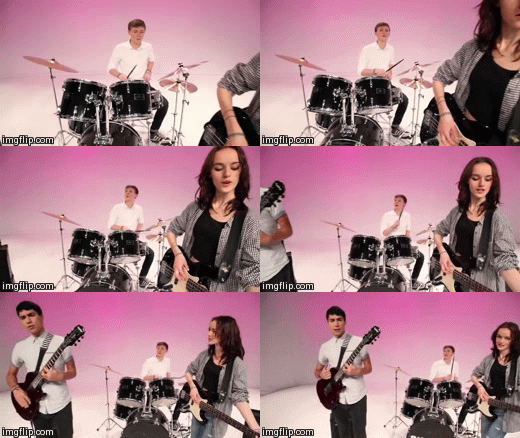
OUR MUSIC VIDEO

OUR MUSIC VIDEO

^OUR MUSIC VIDEO

Pilgrim Album

Pilgrim Album

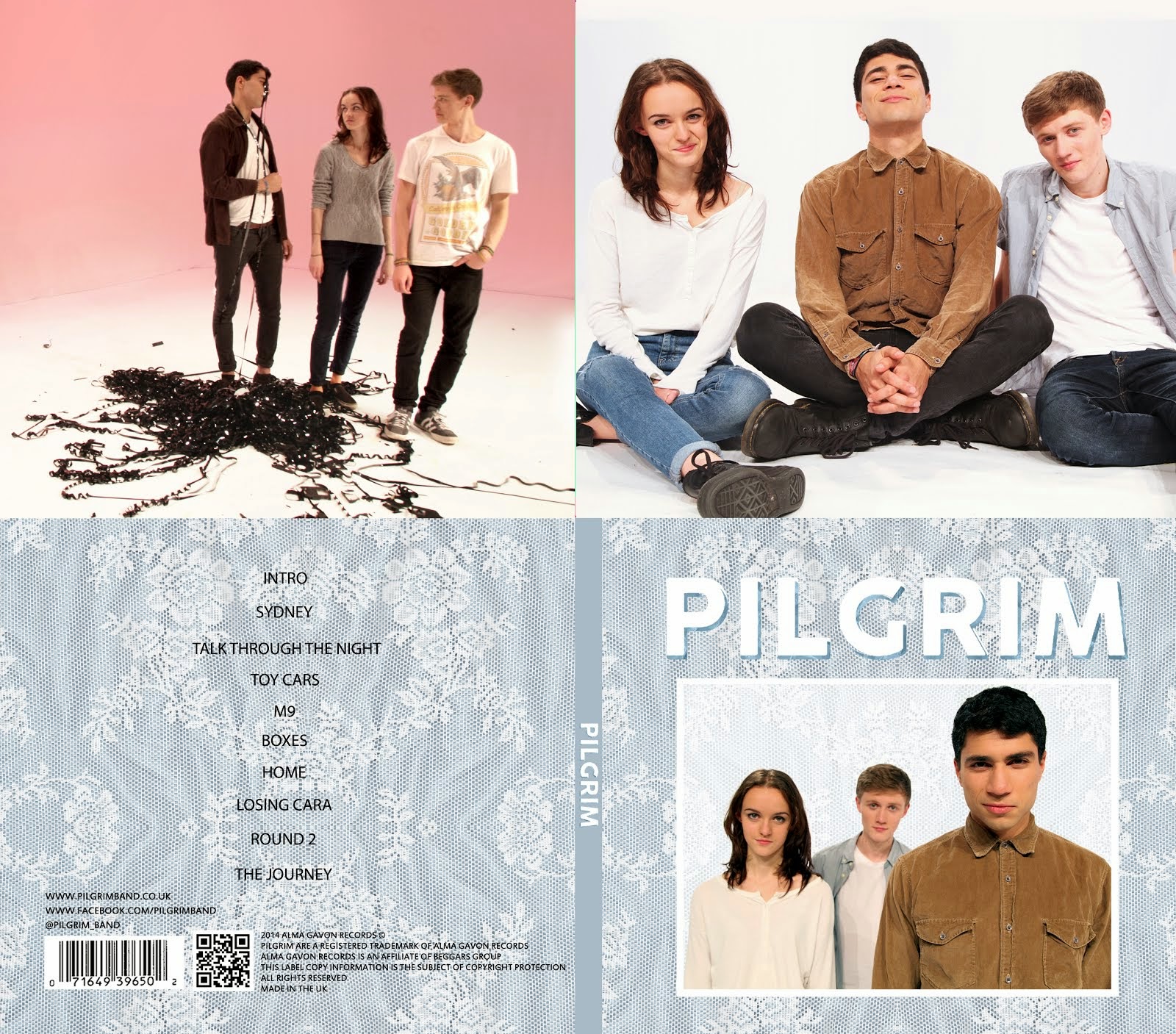
OUR DIGIPAK top to bottom, left to right: inside back, inside front, back cover, front cover.

^OUR DIGIPAK top to bottom, left to right: inside back, inside front, back cover, front cover.

Click on image to view our website

Click on image to open our band website in new window

OUR WEBSITE
My name is Kayvon Nabijou (0610). My production group number is 1 and I am working with Gavin Fraser (0245), Mahalia John (0345) and Alice Cahill (0130). This blog can be navigated by using the labels list on the right hand side of the blog.

Wednesday, 7 January 2015

[2] - How effective is the combination of your main product and ancillary texts?

When preparing to construct our main product and ancillary texts, we thought carefully about the branding of our band and our band's distinct image and identity. We understood that for a product to appeal to plural audiences, it must contain messages that can be interpreted in different ways.

Synergy

When constructing an image for a band or artist, one must think about the style and image that the band or artist wants to convey. This is achieved through a consistent brand across different media platforms, known as synergy. This is a must for bands and artists wishing to promote themselves to their audience. Below is an analysis of how The 1975 use synergy across their media platforms.


Below is how we treated our products with regard to a synergistic campaign.


Band Identity

We understood that, for an audience to buy into a band, the identity of the band has to be very clear. When considering how to create an image for our band, we started by creating individual personalities for each band member, including names. We drew on Richard Dyer's theory on 'star image', where he says that a 'star' is a constructed, artificial image. They can represent cultural values and often are constructed to provide audiences with a type of 'role model' from which people can establish some ideas of 'what they are supposed to be'. Examples of real 'pop stars' who have their own personality outside of their music include Beyonce and Lady Gaga. Below is a Prezi showing the considerations of band image in an existing band - The 1975.


And below is how we attempted to create our own band identity throughout our three products:


(press the pause button to stop the slideshow on each slide if it moves too fast)


Our Website

When it came to linking our three products together, our website was what made this possible. It acted as a hub for our whole campaign, allowing viewers to access social media through the home page, as well as promoting the album and music video. Through this hub, the audience has a lot of opportunity for interactivity and purchasing.


Interactivity


Purchasing

Overall, I think our main product and ancillary texts work well together. Having said this, I think we could have dedicated more thought and time into making sure we had a clear idea of our branding, style and identity.

Tuesday, 6 January 2015

[3] - What have you learned from your audience feedback?

Before we considered audience feedback, we thought as a group what kind of video would appeal to our audience. We took a pluralist approach to audience gratifications in that we considered what different audiences would be able to gain from our products. To do this, we had to establish our audience.

Target Audience

Primary Audience - indie fans of all ages

We chose this group as our primary audience as we are an indie band and so this audience seemed appropriate. Age isn't much of a barrier in the indie genre - people of all ages attend indie gigs and festivals, and so we kept this primary audience fairly wide to extend our reach as much as possible whilst still keeping the audience small enough for a real core fan base.

Consumption Habits

The younger end of this target group (16-24 year olds) will listen to music on websites such as YouTube, Soundcloud or Spotify. They may also illegally download tracks from sites such as uTorrent. The older end of the age group (30+) will have more disposable income and so will be more likely to buy the CD or single. Across the whole primary audience, people will be inclined to buy the vinyl also, as there has been a surge of vinyl purchases, especially from younger indie fans. The entire target group will also buy gig tickets to see the band live, as they take their music very seriously and will want to experience the band as much as possible if they are invested in the band image.

Secondary Audience - British 16-24 year-olds

 Because Pilgrim is a British band, we thought that a secondary British audience would be appropriate as they would appreciate the UK indie culture more than other audiences, and many British 16-24 year-olds will listen to some type of indie music as it is so widespread. Also, the particular age means that they may be able to relate to some of the themes and messages expressed by our band about nostalgia, as they will have grown up at a time similar to our own.

Consumption Habits

This group will either stream music through sites such as YouTube, Soundcloud or Spotify, or they may illegally download music from sites such as uTorrent. They are less likely to be buying tickets to an indie gig as they won't be as invested in the music and the band.

Tertiary Audience - all music lovers


Our tertiary audience is extremely wide. We hope that, because the main messages from our band are very universal, lots of music fans will be able to appreciate it.


Uses and Gratifications

When making creative decision regarding our three artefacts, we almost always referred to Katz & Blumler's theory of 'uses and gratifications'. This states that there are a handful of key reasons why audiences consume any type of media products. Below is how this has been applied to an existing media text ('Cape Cod Kwassa Kwassa' by Vampire Weekend) and how we have applied it to our own music video.


Audience Feedback

According to Stuart Hall, different audiences (or even individuals within specific audiences) will interpret (decode) a media text in different ways for various reasons. Whilst there is always a dominant interpretation of the text - in our case, a sense of nostalgia and looking back on our childhood - there are always other ways that audiences can decode texts - negotiated decoding and oppositional decoding. In our case, this may come across as a message of anger towards our childhood memories. Due to these different ways of decoding messages, audience feedback is essential throughout the course of the project.

Construction

Throughout the course of us constructing our three texts, we received regular feedback, mainly from our classmates, many of whom are indie fans and so fall in the category of our primary audience. They are also of an age at which the values and messages of the video will resonate most strongly in them, and so will be able to give the most focused feedback.


In our first draft, Mahalia thought that the above shot looked odd, in that the camera movement and revealing of Gavin didn't look natural and wasn't pleasant to watch. Gavin quite liked the shot, and so we got feedback from classmates, who also thought the movement in the shot wasn't natural. Therefore, we replaced the shot with the shot below. We felt that this shot was a lot smoother and more natural.


When constructing our digipak, we initially planned to use the picture below on our front cover. We felt that this picture represented our playfulness as a band and the direct address made us seem approachable.


However, the general feedback that we got was that the image wasn't serious enough for a front cover as it made us just look like three friends and not a stylised band. We decided instead to use the image on an inside panel, and instead asked for feedback for the below picture for the front cover - the feedback for which was much more positive.


When constructing our website, one useful piece of feedback was to do with the visuals on the website. Our website featured a good set of visuals on every page, apart from on the tour page, which didn't have any visuals:


To fix this, we decided to add the same image that appears on the sliding panel on the home page to the tour page, to make it more visually appealing.


Final Product

Music Video

We made a survey using Surveymonkey to widen our audience feedback to our secondary and tertiary target audiences, as well as providing for a wider spread of results. Below is the embedded survey:


Below are some important trends that we found in the survey:

1. The majority of participants understood the genre to be indie.


Having said that, some people understood the genre to be pop. This may be because of the crossovers of genre that people listen to, or because of the bright colours used in our video, giving it a pop-like feel.

2. The majority of participants understood the themes to be about fun and friendship.


Unfortunately, not many people picked up on the theme of nostalgia, although we did get some responses to this question that seemed to understand this such as  'looking back at your childhood and about friendship'.

3. The bright background colours were successful and enjoyed by viewers.


Digipak

We didn't use a survey on Surveymonkey for the album cover - instead, we took a few one-to-one surveys.

one participant looking at the album cover
We didn't discover much new from these surveys, but this strengthened what we were hoping:

1. The personality of the band comes across effectively in the digipak. The participants regularly used phrases such as 'laid-back', 'fun', 'approachable' and 'friendly'.

2. The indie genre comes across. Some participants also got a sense of folk or 'folk-rock', possibly because of the lace texture.

3. The colour-scheme works effectively with the personality of the band to create a strong sense of band identity.

4. One comment we got was that there could be more information on the digipak, such as who the songs were by, lyrics, or band information for people who didn't want to go on the website to find it. Whilst we wanted to keep the digipak quite simplistic, in hindsight, we could have perhaps included a brief summary of the band and what we represented and where we originated.


Website

As with the album cover, we conducted one-to-one surveys for the website also.

a participant looking at the website
All of our participants were thoroughly impressed with the website, and again, most of our feedback just strengthened what we already hoped:

1. The personality of the band was described as 'fun', 'quirky', 'down-to-earth', 'approachable', and 'friendly'.

2. The genre was always described as some type of indie or indie rock.

3. All our participants gave our website a 5/5 for interactivity.

4. Most of the participants commented on the fact that the home page doesn't feel cluttered, despite having a lot of content on it, possibly due to the use of boxes for each 'post'.

5. The idea of a vintage feel was also picked up on by most people, and the colour-scheme complimented the bands personality.


Overall, I think our audience feedback in the early stages of our planning and construction helped us to fine-tune our products to appeal strongly to our target audiences, meaning feedback after the products were finished only strengthened this.


Monday, 5 January 2015

[4] - How did you use new media technologies in the construction and research, planning and evaluation stages?

Throughout the project, we used lots of different types of media technologies, for planning, communication and production primarily. Below is a mind map of all the technologies that we used throughout the project:


Blogger

A segment of my blog
Throughout our project, we used blogger to post progress on our project. This was extremely useful as we could use our blogs as references later, or to hold resources that we may need throughout the project.


Research and Planning

Communication

As we had a lot of research and planning to do before the shooting began, we found that social media was very useful in staying in contact. The most useful aspect of this was that we made a group on Facebook for posting questions to the group and for progress updates, as well as having a little group chat for less important things. It was due to technologically converged products such as smartphones (which we all own), that everyone was easily reachable at most times if there was anything that needed discussing.

the top of our Facebook group

an early section of our group chat on Facebook


Facebook was used through our smartphones to access the group at any time
The Facebook messenger app could also be used to access the group chat


Props

The existence of online shopping made acquiring the various props we needed for our video much easier than if we would have had to go to different shops to buy each prop. The main sites we used for props were Amazon and GO International.


Picking a song

When we were all individually choosing songs as possible choices for the music video, I used Spotify and iTunes. These were particularly useful because if I had an idea of a song, both could suggest similar songs, which may have reminded me of songs I wouldn't have otherwise thought of.


my Spotify library
my iTunes library


Construction

Studio Equipment

The Canon 5D Mark II was the camera we used to shoot our music video, album cover and publicity shots. This was a perfect camera for us as it provided a high quality of footage, and was lightweight, which was perfect for our glidecam and shoulder mount footage.


The settings on the camera were also very useful for getting the right look, meaning we had to do less grading. For example, we could increase the exposure to make the background colour look more vibrant. One downside of the Canon 5D Mk II was that the autofocus on it didn't always work properly, meaning that big chunks of the glidecam footage was completely useless because at least one of the band members would be out of focus.

We used Arri Redhead 100k lights and a Leapfrog lighting desk. Both were very simple to use - the lights had colour filters on them which were easily changeable using the lighting desk. The desk had sliders to change the intensity of the lights as well as the colour filter over them. We could also save pre-set lighting setups to the computer, meaning we could easily set up the studio at the start of each shoot.

me saving a lighting setup
Whilst I can find no real flaws in the lighting desk, there were some downsides to the lights. The position and focus of the lights had to be adjusted manually, meaning when another group had been in the studio before us, we would have to reset the lights manually back to their positions. This was very difficult to get exactly the same each time, as well as taking up precious shooting time. Also, some of the colour filters were not aligned properly, meaning it was hard to get a consistent background colour, which was an issue, but we could resolve this during grading.

Editing

During editing, we used Adobe Premiere Pro to cut our shots together into a music video. This was a very effective software as it allowed us to easily trim our clips and put them into a visible timeline.

Website

We used Wix to create our website. This was fantastic as it meant that we didn't have to know HTML code whilst still making a professional-looking website. It was very easy for adding any type of medium into the website, and was very user-friendly. The bar on the left hand side of each page meant that it was very easy to customise our website, which was very important for us as we had to establish a clear branding through the website.

One downside of Wix was that it crashed when opened in Google Chrome, which meant we had to be careful as to which browser we were using. Also, if more than one of us opened our website at the same time to edit it, one of us wouldn't be able to save, meaning we had to make sure we communicated effectively to avoid work being lost.

Wix had some preset layouts that really helped when creating effective pages, such as the store page and the gallery pages.


Evaluation

Throughout this evaluation, different technologies have helped me a lot to gain information as well as present information. Below are a few of them and how they have helped.

Surveymonkey

To get some audience feedback, we decided to create an online survey using Surveymonkey. This is a website that allows users to create their own survey and for anyone to answer. This was very useful as it meant we could potentially get a very wide range of people answering our survey. Whilst free users can only post 10 questions, this was not much of an issue for the type of feedback we were looking for. The results are all very visible, making it easy to spot trends or see what the spread of your interviewees are.


Whilst we would have wanted more of a range of ages, this was a very useful tool in gathering feedback.

Social Media

This was, again, very important, mainly for giving our survey the widest possible reach.

We posted the survey to our Facebook pages to try and get our Facebook friends to answer it.


We also posted the video and survey to the Facebook page and Twitter feed of Dog is Dead, the band who wrote 'Talk Through The Night'. We thought that this would help us get some focused feedback from our core audience, as the core audience of Dog is Dead is similar to that of our own.


Without social media, we would not be able to get anywhere near the same quantity or quality of feedback.

Gifs

I frequently used gifs throughout my evaluation to illustrate some of my points that couldn't be shown as effectively using just images. Whilst gifs are very useful illustrative tools, there were some difficulties creating them, as I had to often change between three different gif sites ('GifYoutube', 'Make A Gif' and 'imgflip') because of restrictions on some videos or technical maintenance on sites.

Slideshows/Presentations

These were very effective I felt in presenting my information. I could easily incorporate images and videos if I needed to. The web-tools I used were Prezi and Emaze to create presentations. Prezi, once I was used to it, I felt was very smooth to operate and was visually very appealing. Emaze felt a bit more cramped and less free to use, but it was very easy to insert multimedia of all sorts, which was useful.


On the whole, I think I used a very wide range of new media technologies throughout the project to aid me and my group throughout the different stages of the project.

Friday, 19 December 2014

Final Editing

Once grading was finished, there were two main differences we added to the video before we were finished with it. Firstly, Gavin thought it would be a good idea to scale up some of the shots slightly as they looked a bit empty, for example, the monopoly shot:


before scaling up
after scaling up
It was a small difference, but it makes the shot look a bit more full. However, we could only scale up a maximum of 15%, otherwise the loss of quality would be noticeable.

Secondly, we needed to add a title on the last shot. There were two reasons for this. Firstly, from our most recent audience feedback, we realised that we needed to have a clearer ending, and so using a title with the band and track name would bring the video to a clear ending. Secondly, it's the last thing that the viewer sees in the video, creating a synergistic brand with the video and the band. We got this idea from lots of existing music videos:

George Ezra - Blame it on me
Dinosaur Jr - Watch the Corners
M83 - Midnight City
Below is how we used text over our image. Our text is a lot bigger and is clearly the focus of the image as the band in the background are out of focus slightly.


Thursday, 18 December 2014

Music Video: Third Cut


In this cut, the main differences are that the close-ups of Gavin and Alice with 3D glasses have been removed, we added a couple more MCU's of Gavin and Alice lip-syncing, and the final section of the video now has a much faster editing pace, as well as some extra shots being added in this section such as the handheld shots of us messing about on the floor with confetti.

We made our feedback much more focused this time, asking a set of people, some media students, some not. We asked a few set questions:

  • What genre does this music video fall under?
  • Who do you think is the target audience?
  • What is the message conveyed by the video?
  • Describe the band.
  • Favourite part?
  • Least favourite part?
The majority of our feedback was positive and what we were hoping for. The main thing we picked up on from feedback is that the ending isn't clear enough. To fix this, we added a title of the band and track over the last shot and got rid of the fade on the last shot to establish a clear ending.

Tuesday, 16 December 2014

Grading

Once we finished our choices on order of shots, we moved on to grading. We weren't planning on doing anything controversial with grading - our main focuses with grading were skin tone and background colour. As some of the white light washed out the background colour a little bit, we could now work on this to make the shots look much more vibrant.


The split-screen on the right shows the difference between the original and graded shot. the left half of the screen is ungraded, and the right half is graded. To get this effect, we used the 3-way colour corrector to make the blues more vibrant. We also used ProcAmp to turn the brightness, saturation and contrast up for this particular shot.


Grading didn't take as long as I had expected it to, because a lot of our grades we could copy onto other shots with the same set-up, meaning it only took a few days from start to finish amongst other things.